Overview
Students will explore the history and engineering of covered bridges through hands-on design and research. Using recycled materials, students will construct their models of covered bridges, gaining insight into both historical context and structural design.
Each group of students will select a covered bridge in New Brunswick to research as part of their investigation. They will examine when the bridge was constructed, why it features a cover, its geographical location, how covered bridges are built, and the historical and practical benefits it has provided over time.
Students will also study the architectural principles behind the construction of covered bridges to inform and guide their own model-building process. The activity will culminate in a showcase, where students will present their bridges along with a summary of their research findings.
NB Curricular Connections
English Language Arts
- Strand: Reading – Big Idea: Reading Comprehension – Skill Descriptor: Construct meaning from a variety of text considering the source, intended audience, and purpose
- Strand: Interactions – Big Idea: Expression – Skill Descriptor: Summarize and present content to communicate facts, ideas, and opinions.
Mathematics
- Strand: Shape and Space – Big Idea: 2-D Shapes and 3-D Objects
Technology
- Strand: Design Thinking Skills – Big Idea: Problem Solving – Skill Descriptors: Construct, execute and present a project within given parameters and with assistance
Personal Wellness
- Strand: Career Connected Learning – Big Idea: Experiencing Potential Career Pathways – Skill Descriptors: Engage in frequent and ongoing career connected experiential learning about preferred career pathways and develop personal competencies
What You’ll Need
- Covered Connections PowerPoint (see download)
- Recycled materials to build such as cardboard, string, popsicle sticks, paper, straws, aluminum foil, toothpicks, etc.
- Rulers, measuring tapes, protractors
- Paper & pencils, markers, tape, scissors
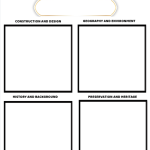
- Graphic organizer (provided)
- Digital tools (optional): tablet/computer for research
Instructions
Phase 1: History of Bridge Construction
Teachers will begin with a group discussion with their students asking the following:
What were the first bridges constructed of? How have bridges changed over time?
Show slide 3 of PPT of bridge photographs to students. Focus on how these bridges are constructed, their intended functions, and where they are typically found.
Engage in a class discussion to examine:
- The similarities and differences between various bridge types
- How building materials and time in history influence bridge building
Review slides 4-10 of PPT for more detailed information about the history of bridges.
This foundational knowledge will support students in the next phase of their learning.
Phase 2: Researching New Brunswick Covered Bridges
Students will each select a covered bridge located in New Brunswick to research in detail. Using the graphic organizer and slides 11 & 12, their investigation will address the following key questions (more on PPT) organized through four key domains; Construction & Design, Geography & Environment, History and Background, Preservation & Heritage
- When was the bridge built? Where is/was it located?
- Is it still in use? Has it been torn down? If so, when? How long is it?
- What body of water did it cross? What communities does/did it connect?
- What are/were the cultural/community benefits of this bridge?
- Should we protect these culturally/community significant bridges? Why or why not?
Phase 3: Covered Bridge Construction
Students will use the Phase 1 history knowledge and basic bridge engineering/construction principles and their Phase 2 covered bridge research to apply in the hands-on building portion of this phase.
Students will construct a representative model of their NB covered bridge using available materials (cardboard, glue guns, string, popsicle sticks, tape, paper, straws, aluminum foil, toothpicks, etc). Encourage the use of recycled materials from your classroom/school!
Using slides 13-17 of PPT, have students review the suggested construction practices. The focus will be on applying real-world design principles while encouraging sustainable practices through the reuse of materials.
Phase 4: Presentation and Showcase
Students will present both their bridge models and research findings. Presentation formats may include (but are not limited to):
- PowerPoint or Canva Presentations
- Poster or Trifold Board
- Video Presentation or Digital Story
- Blog post or class website
- Podcast or Audio Recording
- Written Research Report
All presentations must show research depth, creativity of construction, understanding of bridge concepts, and clarity of communication.
All presentations will address the four key domains; Construction & Design, Geography & Environment, History and Background, Preservation & Heritage
Make Meaning Activity
Please see the downloadable Make Meaning document for several choices on how you and your learners can reflect upon today’s activity. This is an important step in the experiential learning cycle.
Extension Ideas
- Heritage Fair – Teachers are encouraged to explore opportunities for students to showcase their work at a local Heritage Fair. This event allows students to present their projects to a wider audience, celebrating local history and student achievement in meaningful and authentic ways.
- Short Story – Encourage students to write a short story (fictional or historical) about their covered bridge of choice.
- Field Trip – Travel to and explore an actual remaining covered bridge near to your school.