
Overview
Students will explore how to use ArcGIS software using data on the New Brunswick Agricultural sectors. This module investigates the impact climate change has on New Brunswick Agricultural zones, the vocabulary of agriculture, and analysis of historical data on climate and agriculture in New Brunswick.
Outline of Module (can be completed over 5 classes)
- Part 1: Exploring NB Agricultural Zones
- Part 2: Climate Change and Agricultural Futures
- Part 3: Site Visit
Supplies
- Laptops/iPads
Module Outline
Part 1: Exploring NB Agricultural Zones
1.1 Hook
- “You’re starting a farm in NB. Where should you buy land? Today you’ll use the same tool real farmers and the government use to make this decision.”
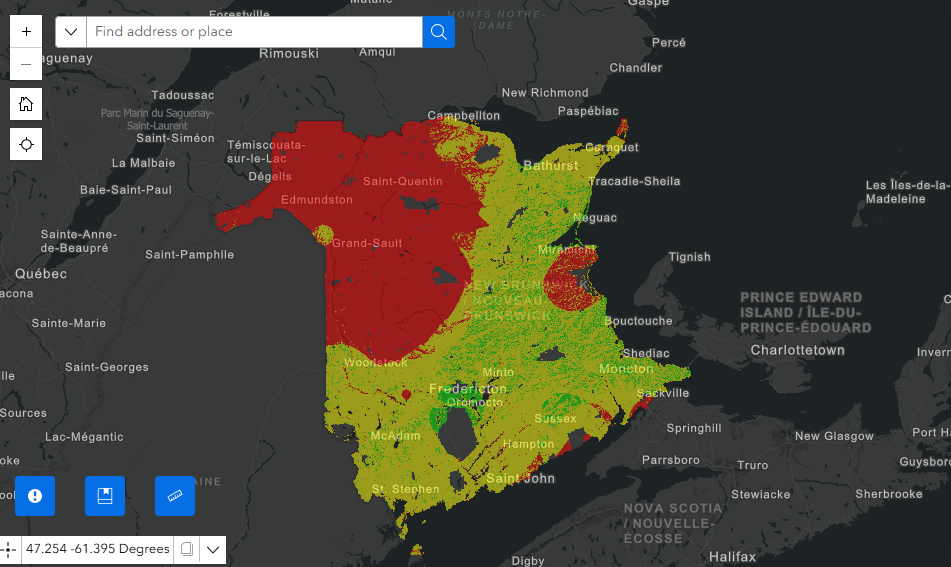
- Explore Agriculture Suitability map
- Show the crop maps side-by-side: “Notice anything interesting?”
1.2 Guided Exploration
Students work in groups, each pair assigned a different crop:
- Potatoes
- Corn
- Apples
Students visit the Agriculture Suitability map. Guide students through features in ArcGIS (map layers, legend, bookmarks, coordinates, location search, zoom in/out)
1.3 Student Worksheet – Part 1:
Explore Your Crop Map
- Navigate to your assigned crop suitability map. Find and mark on a paper NB map:
- 3 “highly suitable” (dark green) regions
- 3 “unsuitable” (red/orange) regions
- Click on different colored zones. What factors make a zone “suitable” or “unsuitable” (Appendix A)?
- Growing degree days: _____
- Frost-free days: _____
- Soil drainage: _____
- Slope: _____
- Pattern Recognition: “Where in NB is best for your crop?
Gallery Walk: Look at another group’s crop map. How does it differ from yours?
Class Share
- Each crop group presents: “Our crop grows best in _____ because _____”
Exit Ticket Question: “Why might apples grow well where potatoes don’t?”
Part 2: Climate Change & Agricultural Futures
2.1 Climate Connection
Present the climate data behind the maps. Using Climate Atlas of Canada, search for your local area or click FIND ME. In the Variable tab, choose Frost-Free Season.
- “These maps show frost-free days and growing degree days NOW”
- Show historical data (Appendix B): “50 years ago, NB had 10-15 fewer frost-free days”
- Show projection: “By 2050, could have 15-20 MORE frost-free days”
Key insight for students: The green and red zones of the suitability maps will SHIFT as climate changes.
2.2 Scenario Analysis Activity
Depending on skills, you may want to display the data with this slide deck OR allow students to explore Climate Atlas.
Student Worksheet – Part 2:
Students will revisit worksheet from previous class.
- Look at your crop’s requirements:
- Minimum frost-free days needed: _____
- Growing degree days needed: _____
- Use the climate data provided:
- If frost-free days increase by 15 days, what regions that are currently “marginal” (yellow) might become “suitable” (green)?
- Have students mark these on their map with a star
- Placemat Worksheet: Have students complete placemat activity with the following
- Evidence-Based Prediction: “Based on climate projections, our crop’s growing zone will likely move _____ (north/south/expand/shrink) because _____”
- Opportunity: Which NB region might benefit most from longer growing seasons? Why?
- Challenge: What new problems might warmer weather create? (Think: pests, water needs, extreme weather)
- Data gaps: “What other information would you need to be confident about your predictions?”
- Class Share – Exploring Careers in NB Agriculture
*Teacher Note: For information on specific careers in New Brunswick agriculture and food production, please refer to THINKAG.
Present students with the following scenario (could be done in groups):
You’ve decided to become farmer in northern NB, currently in an orange/unsuitable zone. Climate projections suggest your area will become suitable in 20 years.
- Should you invest in planting this crop now? Why or why not?
- What are the risks and opportunities?
- Propose one way NB’s agricultural sector could adapt to changing climate suitability zones. What careers might be needed? (climate scientists, agricultural advisors, etc.)
2.5 Class Discussion & Synthesis
- “Is climate change simply moving the green zones north?”
- “What could this mean for NB’s economy? Food supply?”
- “What careers might be needed?” (climate scientists, agricultural advisors, etc.)
Part 3: Site Visit
*Teacher Note: For information on farmers and food producers in your region, please connect with Agriculture in the Classroom, The Agricultural Alliance of New Brunswick, the Department of Agriculture, Aquaculture and Fisheries, or the Centre of Excellence for Digital Innovation.
- Visit:
- Invite a local NB farmer to guest speak, and learn about how they are adapting to climate change OR
- Engage in a site visit to a local farm producing one of the 4 crops investigated for experiential learning on adaptations NB farmers are making in response to climate change
Connections to Curriculum Standards
New Brunswick Science 6-8
Big Idea: Sensemaking
Skill Descriptor: Analyze and interpret qualitative and quantitative data to construct explanations and conclusions.
Achievement Indicators:
- Interpolate or extrapolate from patterns or trends in collected data
- Identify new questions that arise from scientific inquiry or new information
New Brunswick Agriculture 110
Big Idea: Agriculture Career Connection
Skill Descriptor: Explore agriculture careers
Achievement Indicators:
- Share how agriculture education may impact own career path
Extension Activity
Future of New Brunswick Agriculture
- Knowing how crop suitability will change over the years, consider how this will impact the use of crops for other sectors (i.e. eggs, poultry, sustainability)
- Connect with groups like Egg Farmers of NB, Potatoes NB, NB Pork and/or Nutrients for Life to extend learner understanding and appreciation for how climate change is impacting the agricultural/food production industries in NB
- Invite local producers or members of agricultural groups like New Brunswick Agricultural Alliance, Agriculture in the Classroom, Egg Farmers of NB, Potatoes NB, NB Pork and/or Nutrients for Life for a panel discussion at your school. Have students prepare questions in advance based on their explorations of crop suitability and climate change.